Learn · After training
Post-workout recovery: what to do after a workout
What you do in the hours after a workout shapes how you feel and perform at the next one. Here's a simple, step-by-step post-workout recovery routine, from the first few minutes to the next day, with what the research says about each step.
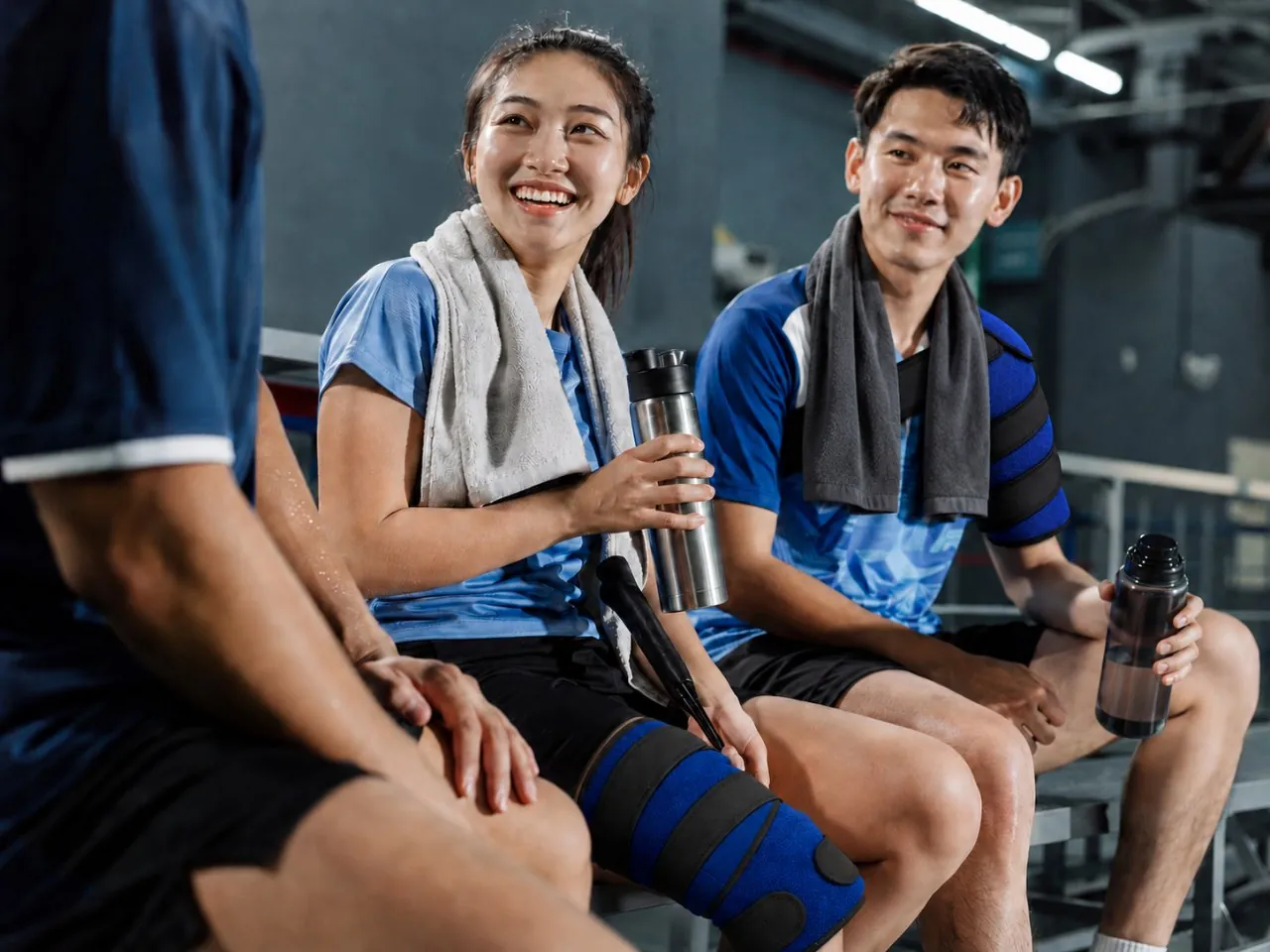
General information, not medical advice. For an injury, or pain that is severe or not improving, see a doctor or physiotherapist.
After a workout: cool down if you like (it feels good but isn't essential),[1] rehydrate by drinking more than you lost with some sodium,[2][3] eat carbohydrate and 20–40 g of protein within the next few hours,[4][5] ease sore areas with cooling, compression or massage,[6][7][8] go easy on alcohol,[9] and get a good night's sleep.[10] The next day, train easy or rest and let soreness settle.[11]
Step 1: Cool down (optional)
A few minutes of easy movement at the end of a session feels good and helps you wind down. But if you skip it, you're not missing a key part of recovery.
A review of active cool-downs found they speed up clearance of lactate from the blood and may help the heart and breathing settle faster, but are largely ineffective for same-day and next-day performance, don't appear to prevent injuries, and mostly don't reduce muscle soreness.[1]
Step 2: Rehydrate
Weigh yourself before and after a long or sweaty session. The difference is roughly the fluid you lost. Drink a bit more than that over the next few hours, and have something salty or an electrolyte drink with it, so your body keeps the fluid instead of passing it straight out.
The ACSM recommends estimating individual sweat rates from body weight before and after exercise, aiming to prevent losses of more than 2% of body weight during exercise, and replacing any fluid and electrolyte deficit afterwards.[3] In a rehydration study, a drink volume greater than sweat loss was needed to restore fluid balance, but unless the drink's sodium content was high enough, the extra mostly increased urine output.[2]
Step 3: Refuel with carbohydrate and protein
Your muscles have burned fuel and need building materials. A meal or snack with both carbohydrate and protein in the hours after training covers both. There's no need to panic about a 30-minute window.
Glycogen resynthesis is fastest in the first hours after exercise, with about 1 g of carbohydrate per kg of body weight optimising this early phase; restoration continues for up to 24 hours.[4] For protein, the ISSN recommends 20–40 g (about 0.25 g/kg) per serving, every 3–4 hours. Exercise's effect on muscle building lasts at least 24 hours, so timing is largely a matter of individual tolerance.[5] Sports nutrition bodies agree that well-chosen nutrition strategies enhance recovery from training.[13]
Step 4: Ease sore or hot spots
If a joint or muscle group took a beating, deal with it early: cool it down, put compression on, or book a massage. You'll be less sore over the next few days.
Cold water immersion reduced soreness ratings at 24–96 hours compared with rest;[6] a meta-analysis found the best results at about 10–15 °C for 10–15 minutes.[14] Compression garments have a moderate effect on DOMS,[7] and massage is the most effective technique overall.[8] If you're training for muscle size, avoid routine whole-body cold straight after strength sessions.[15] All DOMS treatments ranked →
Step 5: The evening: food, drinks and sleep
Have a proper meal with protein, keep the drinks sensible, and get to bed on time. This is where most of the rebuilding happens.
Heavy drinking after training (about 12 standard drinks) reduced muscle protein synthesis by 24% even when protein was also taken.[9] One night of total sleep loss cut muscle protein synthesis by 18% and shifted hormones toward breakdown.[10] Pre-sleep casein (30–40 g) increases overnight muscle protein synthesis.[5]
Step 6: The next 1–3 days
Make the next day easy or a rest day, especially for the muscles you worked hardest. If you're sore, gentle movement, massage or foam rolling helps, and once the soreness has set in, heat may feel better than cold.
DOMS is felt for about 1–5 days and muscle activity eases it temporarily.[11] Foam rolling reduces perceived muscle pain,[16] and in trials heat wraps gave more pain relief than cold once DOMS had set in.[12] Muscle protein synthesis is still raised at 48 hours, so the next couple of days are part of the recovery.[17] Planning rest days →
Adjust it to the session
| After… | Prioritise |
|---|---|
| Strength training | 20–40 g of protein;[5] skip routine whole-body cold if muscle size is the goal[15] |
| Long endurance session | Carbohydrate first, with protein to help offset muscle damage[5][4] |
| Training in the heat | Fluids with sodium,[2][3] and cooling down the whole body[18] |
| Two sessions in one day, or a tournament | Carbohydrate soon after, to use the fast early phase of refuelling[4] |
| A new or eccentric-heavy workout | Expect DOMS; ease it with massage, compression or cooling[8][7][6] |
Common post-workout mistakes
- Not eating because you're not hungry, or only having a shake when you needed carbohydrate too.[4][5]
- Drinking only plain water after a very sweaty session, so much of it is lost as urine.[2]
- A big night out straight after a game or hard session.[9]
- Staying up late.[10]
- Stretching to prevent soreness: it doesn't make a meaningful difference.[19]
- Hammering the same sore muscles again the next day.[20]
Where Recoolvery+ fits
Recoolvery+ is not an ice pack. It's a cooling recovery wrap for Step 4: freezable HypoCarbon® pads (35.0 W/m·K in in-house testing, against about 2.3 for ice)[21][22] strapped on the knee, shoulder, elbow, ankle or back that worked hardest, hands-free for 15–60 minutes while you rehydrate and refuel.[23] It fits in a gym bag, so you can start straight after the session.
Questions
What should I do after a workout?
Rehydrate, eat carbohydrate and protein within the next few hours, ease sore areas with cooling, compression or massage, go easy on alcohol and sleep well. A cool-down is optional. Make the next day easier for the muscles you worked hardest.
What should I eat after a workout?
A meal or snack with carbohydrate to refill muscle fuel and 20 to 40 g of protein for repair. After long endurance sessions, prioritise carbohydrate; after strength sessions, make sure you get enough protein.
How soon after a workout should I eat?
Within a few hours is fine for most people. Exercise's effect on muscle building lasts at least 24 hours. If you train again the same day, eat carbohydrate soon after, because muscle fuel is restored fastest in the first hours.
Is a cool-down necessary?
Not really. Research shows active cool-downs clear blood lactate faster and may help the heart and breathing settle, but they don't improve next-day performance, prevent injuries or meaningfully reduce soreness. Do one if it feels good.
How much should I drink after a workout?
Weigh yourself before and after to estimate the fluid you lost, then drink more than that over the next few hours, with some sodium from food or an electrolyte drink so your body retains it.
Should I take an ice bath after a workout?
Cold water immersion reduces soreness over the following days, with the best results around 10 to 15 °C for 10 to 15 minutes. If you're training for muscle size, avoid it routinely after strength sessions, as it can blunt long-term gains.
References
- Van Hooren B, Peake JM. Do we need a cool-down after exercise? A narrative review of the psychophysiological effects and the effects on performance, injuries and the long-term adaptive response. Sports Medicine, 2018. doi.org/10.1007/s40279-018-0916-2
- Shirreffs SM, Taylor AJ, Leiper JB, Maughan RJ. Post-exercise rehydration in man: effects of volume consumed and drink sodium content. Medicine & Science in Sports & Exercise, 1996. doi.org/10.1097/00005768-199610000-00009
- American College of Sports Medicine; Sawka MN, Burke LM, Eichner ER, et al. Position stand: Exercise and fluid replacement. Medicine & Science in Sports & Exercise, 2007. doi.org/10.1249/mss.0b013e31802ca597
- Burke LM, van Loon LJC, Hawley JA. Postexercise muscle glycogen resynthesis in humans. Journal of Applied Physiology, 2017. doi.org/10.1152/japplphysiol.00860.2016
- Jäger R, Kerksick CM, Campbell BI, et al. International Society of Sports Nutrition position stand: protein and exercise. Journal of the International Society of Sports Nutrition, 2017. doi.org/10.1186/s12970-017-0177-8
- Bleakley C, McDonough S, Gardner E, et al. Cold-water immersion (cryotherapy) for preventing and treating muscle soreness after exercise. Cochrane Database of Systematic Reviews, 2012. doi.org/10.1002/14651858.CD008262.pub2
- Hill J, Howatson G, van Someren K, Leeder J, Pedlar C. Compression garments and recovery from exercise-induced muscle damage: a meta-analysis. British Journal of Sports Medicine, 2014. doi.org/10.1136/bjsports-2013-092456
- Dupuy O, Douzi W, Theurot D, Bosquet L, Dugué B. An evidence-based approach for choosing post-exercise recovery techniques to reduce markers of muscle damage, soreness, fatigue, and inflammation: a systematic review with meta-analysis. Frontiers in Physiology, 2018. doi.org/10.3389/fphys.2018.00403
- Parr EB, Camera DM, Areta JL, et al. Alcohol ingestion impairs maximal post-exercise rates of myofibrillar protein synthesis following a single bout of concurrent training. PLoS One, 2014. doi.org/10.1371/journal.pone.0088384
- Lamon S, Morabito A, Arentson-Lantz E, et al. The effect of acute sleep deprivation on skeletal muscle protein synthesis and the hormonal environment. Physiological Reports, 2021. doi.org/10.14814/phy2.14660
- Armstrong RB. Mechanisms of exercise-induced delayed onset muscular soreness: a brief review. Medicine & Science in Sports & Exercise, 1984. pubmed.ncbi.nlm.nih.gov/6392811/
- Malanga GA, Yan N, Stark J. Mechanisms and efficacy of heat and cold therapies for musculoskeletal injury. Postgraduate Medicine, 2015. doi.org/10.1080/00325481.2015.992719
- Thomas DT, Erdman KA, Burke LM. American College of Sports Medicine joint position statement: Nutrition and athletic performance. Medicine & Science in Sports & Exercise, 2016. doi.org/10.1249/MSS.0000000000000852
- Machado AF, Ferreira PH, Micheletti JK, et al. Can water temperature and immersion time influence the effect of cold water immersion on muscle soreness? A systematic review and meta-analysis. Sports Medicine, 2016. doi.org/10.1007/s40279-015-0431-7
- Roberts LA, Raastad T, Markworth JF, et al. Post-exercise cold water immersion attenuates acute anabolic signalling and long-term adaptations in muscle to strength training. Journal of Physiology, 2015. doi.org/10.1113/JP270570
- Wiewelhove T, Döweling A, Schneider C, et al. A meta-analysis of the effects of foam rolling on performance and recovery. Frontiers in Physiology, 2019. doi.org/10.3389/fphys.2019.00376
- Phillips SM, Tipton KD, Aarsland A, Wolf SE, Wolfe RR. Mixed muscle protein synthesis and breakdown after resistance exercise in humans. American Journal of Physiology, 1997. doi.org/10.1152/ajpendo.1997.273.1.E99
- Tipton MJ, Collier N, Massey H, Corbett J, Harper M. Cold water immersion: kill or cure? Experimental Physiology, 2017. doi.org/10.1113/EP086283
- Herbert RD, de Noronha M, Kamper SJ. Stretching to prevent or reduce muscle soreness after exercise. Cochrane Database of Systematic Reviews, 2011. doi.org/10.1002/14651858.CD004577.pub3
- American College of Sports Medicine. Position stand: Progression models in resistance training for healthy adults. Medicine & Science in Sports & Exercise, 2009. doi.org/10.1249/MSS.0b013e3181915670
- HypoCarbon® thermal conductivity (35.0 W/m·K): Global Healthcare SG in-house testing of the proprietary formulation. Unpublished company data, available to clinical and trade partners on request.
- Slack GA. Thermal conductivity of ice. Physical Review B, 1980. doi.org/10.1103/PhysRevB.22.3065
- Recoolvery+ product specifications and care guide: session length, refreeze time, pad life and materials. recoolvery.com/products/recoolvery-wrap
Recoolvery+
Cooling for your recovery routine
Not an ice pack. Freezable HypoCarbon® pads in a hands-free wrap for the knee, shoulder, elbow, ankle and back. HypoCarbon® conducts heat 15× better than ice. Cold only, no heating.
See the Recoolvery+ Wrap