Learn
The best ice pack for the knee: six options, compared honestly
Searching for the best knee ice pack turns up hundreds of near-identical products. What matters is simpler: how cold it gets, how much of the knee it covers, and whether it stays on. Here are the six main ways to cool a knee, what the research says about each, and who each one suits.
General information, not medical advice. For an injury, or pain that is severe or not improving, see a doctor or physiotherapist.
The best option for cooling a knee is one that gets properly cold, wraps around the joint rather than sitting on top of it, and stays on without you holding it. A bag of ice cubes with a little water added is cheap and very effective, but messy and hard to keep in place.[1] Flat gel packs are convenient but cool the skin less than ice.[2] Cold therapy machines cover the whole knee but cost about US$150 to US$300 or more. A strap-on cooling wrap sits in between: hands-free, no ice, and one purchase.
We make one of the options below, the Recoolvery+ cooling wrap. We've tried to be fair to the others, and for some people one of them will be the better choice.
What makes a good knee ice pack
| What to look for | Why it matters for the knee |
|---|---|
| Gets properly cold | Packs that start warmer or hold less cold numb the area less[1][2] |
| Wraps around the joint | The knee is round and bony. A flat pack touches only the front, and pain is often at the sides or behind the kneecap |
| Stays on hands-free | If you have to hold it, you'll stop early. Straps let you sit, stretch or work while you cool |
| Flexible from the freezer | A pack that freezes rock-hard bridges across the kneecap instead of touching the skin |
| Doesn't melt or drip | Melting ice soaks clothes, sofas and car seats |
| Easy to repeat | Icing is often repeated every 2 to 3 hours in the first days after a strain,[4] so refreeze time and spares matter |
| Reusable | Lower cost per session than buying ice or replacing split packs |
Six ways to cool a knee, compared
1. A bag of ice (best on a budget)
Ice in a zip bag gets very cold, and adding a splash of water helps it mould to the knee. In a 2009 study, wetted ice (ice with water added) produced the biggest drop in skin and muscle temperature, and crushed ice the smallest.[1] Melting ice absorbs a lot of heat as it turns to water, which is why ice works so well. The downsides: it drips, it slides off a bent knee, and you need ice every time. Always put a thin cloth between the bag and your skin.
2. A bag of frozen peas
The classic stand-in. It drapes over the knee better than a block of ice and is free if you already have it. In a 2005 study it cooled the skin less than an ice pack,[2] warms up fairly quickly, and you'll need to keep refreezing the same bag (don't eat them afterwards).
3. A flat gel ice pack
Convenient, reusable and cheap. Most are mostly water with a thickener. Some freeze stiff; others contain an antifreeze to stay soft, which also means they hold less cold. In the same 2005 comparison, a gel pack also lowered skin temperature less than an ice pack.[2] On a knee, a flat pack mostly touches the front, and it slides off unless you strap it. Gel ice pack vs cooling wrap →
4. A knee ice wrap with a gel insert
A sleeve or strap with a pocket for a gel pack. It fixes the "holding it" problem and covers more of the joint. How well it cools still depends on the gel pack inside, and a thick sleeve can insulate the knee from the cold.
5. A cold therapy machine or cryo cuff (best after surgery, if prescribed)
A cuff around the knee connected to a cooler of iced water, sometimes with a pump. It covers the whole joint and keeps it cold for a long time, which is why surgeons often recommend one after knee surgery. It costs about US$150 to US$300 or more, needs ice and water every session (motorised units also need power), and ties you to the cooler. If your surgeon has prescribed one, follow their instructions. Cold therapy machine vs cooling wrap →
6. A strap-on cooling wrap like Recoolvery+ (best for training and everyday use)
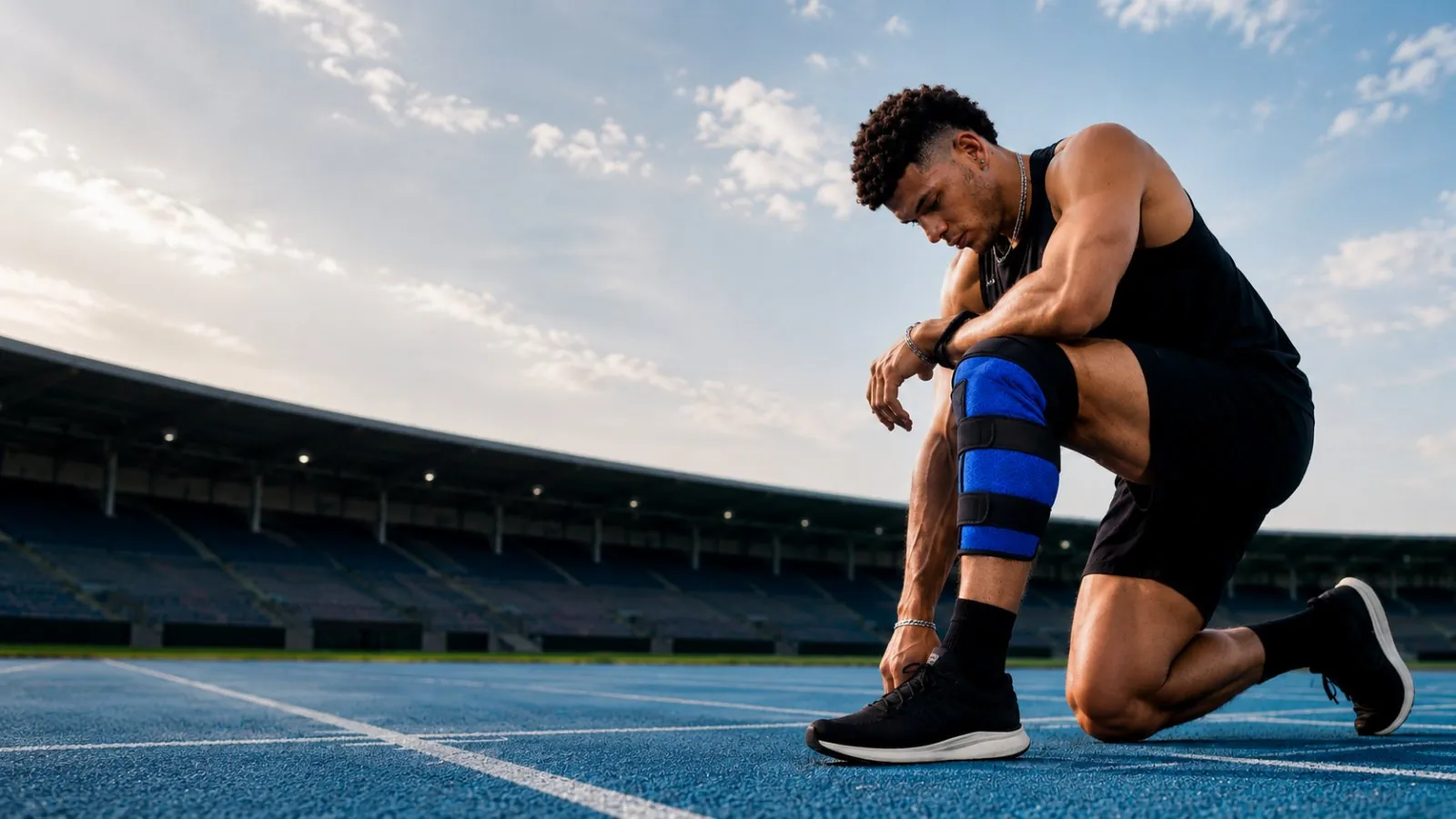
Recoolvery+ is not an ice pack. It's a cooling recovery wrap: freezable HypoCarbon® pads in a cross-shaped holder, held around the knee by three adjustable straps. HypoCarbon® conducts heat about 15 times better than ice (35.0 vs 2.3 W/m·K).[7][8] The pads firm up in the freezer without going solid, so they shape to the joint, and they don't melt or drip. A session lasts 15 to 60 minutes, and the pads refreeze in 2 to 4 hours.[6] It costs US$119 (Standard) or US$139 (XL, for knees 40 cm or more around), once. It doesn't cover the back of the knee the way a machine cuff does.
Side by side
| Bag of ice | Gel pack | Machine cuff | Recoolvery+ wrap | |
|---|---|---|---|---|
| How cold | Very (wetted ice best)[1] | Less than ice[2] | Cold for long sessions | HypoCarbon®, 35.0 W/m·K[7] |
| Covers | Front | Front | Whole knee | Front and both sides |
| Hands-free | No | Only with a strap | Yes | Yes, three straps |
| Mess | Drips as it melts | Condensation; can split | Water in the cooler | None. Doesn't melt or drip |
| Needs | Ice every time | Freezer | Ice, water; power for motorised units | Freezer |
| Portable | No | Yes | No | Fits in a gym bag |
| Cost | Ice every session | Low | About US$150–300+ | US$119 / US$139, once |
| Best for | Occasional use on a budget | Quick, occasional cooling | After surgery, if prescribed | Regular use after training, at home or on the go |
Using cold on the knee safely
Keep a thin layer between very cold packs and bare skin, check the skin after 10 minutes, and take it off if it goes numb, white or painful. Be extra careful on the outside of the knee, just below the joint, where a nerve runs close to the skin.
Case reports describe temporary nerve injury from cold therapy, with the risk depending on how close a nerve lies to the skin, how much fat covers it, and how long the area is cooled.[3] The common peroneal nerve, on the outside of the knee just below the joint, is one of the most superficial. For a fresh strain, the NHS suggests up to 20 minutes every 2 to 3 hours.[4] A systematic review found no evidence for an ideal icing duration,[5] so short sessions with skin checks are the sensible default. How long to ice →
How the Recoolvery+ wrap fits the knee → · See the Recoolvery+ Wrap →
Questions
What is the best ice pack for knee pain?
One that gets properly cold, wraps around the knee rather than sitting on top, and stays on hands-free. Ice with a little water in a bag cools very well but drips and slides. A strap-on cooling wrap is hands-free and mess-free. After surgery, a cold therapy machine is often prescribed.
Is ice or a gel pack better for the knee?
Ice, for pure cooling. Studies found ice packs cooled the skin more than gel packs, and wetted ice (ice with a little water) cooled best of all. Gel packs are more convenient and reusable, and work for quick, occasional cooling.
How long should I ice my knee?
Up to 20 minutes at a time, every 2 to 3 hours for the first few days after a strain, with a cloth between the cold and your skin. After training, 10 to 20 minutes is plenty.
Should I ice my knee after running?
If it's sore or achy, 10 to 20 minutes of cold after the run can ease the pain. If pain is sharp, swollen, or stops you running, see a physiotherapist.
What is the best ice pack for the knee after surgery?
Follow your surgeon's instructions. Many recommend a cold therapy machine or cryo cuff after knee surgery because it covers the whole joint for long periods.
Can an ice pack damage the knee?
Rarely, if used too long or directly on skin. Cold can injure the skin, and case reports describe temporary nerve injury from prolonged cold where nerves run close to the skin, such as on the outside of the knee. Check the skin after 10 minutes.
Is Recoolvery+ an ice pack?
No. It's a cooling recovery wrap with freezable HypoCarbon® pads that conduct heat about 15 times better than ice, firm up without going solid, and don't melt or drip. Three straps hold it around the knee hands-free.
References
- Dykstra JH, Hill HM, Miller MG, Cheatham CC, Michael TJ, Baker RJ. Comparisons of cubed ice, crushed ice, and wetted ice on intramuscular and surface temperature changes. Journal of Athletic Training, 2009. doi.org/10.4085/1062-6050-44.2.136
- Kanlayanaphotporn R, Janwantanakul P. Comparison of skin surface temperature during the application of various cryotherapy modalities. Archives of Physical Medicine and Rehabilitation, 2005. doi.org/10.1016/j.apmr.2004.11.034
- Bassett FH, Kirkpatrick JS, Engelhardt DL, Malone TR. Cryotherapy-induced nerve injury. American Journal of Sports Medicine, 1992. doi.org/10.1177/036354659202000505
- NHS. Sprains and strains. www.nhs.uk/conditions/sprains-and-strains/
- Bleakley C, McDonough S, MacAuley D. The use of ice in the treatment of acute soft-tissue injury: a systematic review of randomized controlled trials. American Journal of Sports Medicine, 2004. doi.org/10.1177/0363546503260757
- Recoolvery+ product specifications and care guide: session length, refreeze time, pad life and materials. recoolvery.com/products/recoolvery-wrap
- HypoCarbon® thermal conductivity (35.0 W/m·K): Global Healthcare SG in-house testing of the proprietary formulation. Unpublished company data, available to clinical and trade partners on request.
- Slack GA. Thermal conductivity of ice. Physical Review B, 1980. doi.org/10.1103/PhysRevB.22.3065
Recoolvery+
Cooling for your recovery routine
Not an ice pack. Freezable HypoCarbon® pads in a hands-free wrap for the knee, shoulder, elbow, ankle and back. HypoCarbon® conducts heat 15× better than ice. Cold only, no heating.
See the Recoolvery+ Wrap