Learn · Soreness
DOMS: why your muscles are sore after a workout
That stiff, achy feeling a day or two after a hard or new workout has a name: delayed-onset muscle soreness, or DOMS. It's normal, it's temporary,[1] and it isn't caused by lactic acid.[2]
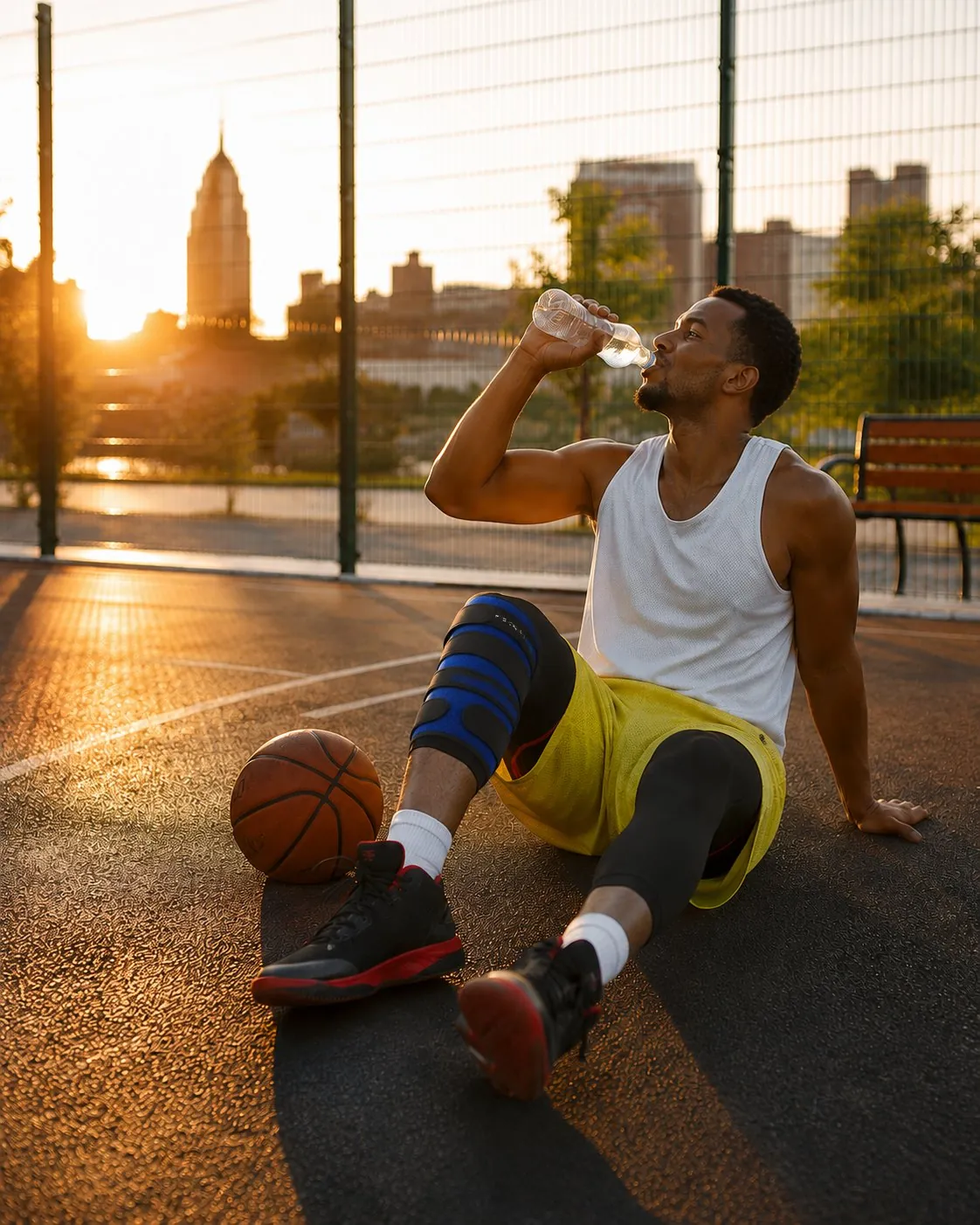
General information, not medical advice. For an injury, or pain that is severe or not improving, see a doctor or physiotherapist.
DOMS is muscle soreness felt from about 1 to 5 days after unaccustomed or intense exercise, usually worst around 24–72 hours.[1][3] It is linked to tiny strains in the muscle fibres, especially from "lowering" (eccentric) work, and the repair process that follows. Easy movement and cooling can make it feel better while it passes.[1][4]
What DOMS feels like, and when
- Tender, stiff muscles that hurt most when you stretch or use them.
- Reduced range of movement, like struggling to walk downstairs after leg day.
- Often worst on the second morning, not the first.
- Most common after something new, a big jump in volume, or a lot of eccentric work: lowering weights, running downhill, landing from jumps.[3][2]
What causes it
When a muscle works hard in a way it isn't used to, especially while lengthening under load, it gets lots of tiny strains. Your body sends in its repair crew, and that repair work makes the area tender for a few days.
The good news: next time you do the same workout, you'll be much less sore.
High tension in the muscle during eccentric work causes structural damage to fibres. The repair process that follows, including immune-cell activity, stimulates pain-sensing nerve endings in the muscle, which is why it hurts when pressed or stretched.[1] Researchers have proposed several mechanisms, and a combination is likely.[3]
Lactic acid isn't the explanation. In a classic study, 45 minutes of downhill running at a moderate effort caused significant soreness, while level running at a higher effort caused none.[2] The body also adapts quickly: one bout of eccentric exercise protects against damage from the next, the repeated bout effect.[5]
Is soreness a sign of a good workout?
Not necessarily. Soreness mostly tells you the exercise was new or the volume jumped, not that it was effective. Experienced athletes often train very hard with little DOMS because their muscles have adapted. Chasing soreness can mean doing more than you can recover from.
How to ease DOMS
A quick summary is below. For every option ranked by the research, see DOMS treatment: what actually helps.
| What helps | Why | Evidence |
|---|---|---|
| Build up gradually | Training the same movement reduces later soreness | Well established: the repeated bout effect[5][1] |
| Easy movement | Light activity eases soreness while you move | The sensation returns afterwards[1] |
| Cooling | Cold slows nerve signals and reduces how sore the area feels | Cochrane review: cold water immersion reduced soreness ratings at 24–96 h (low-quality evidence)[4][6] |
| Gentle heat, a day or two later | Warmth eases stiffness | Trials found a heat wrap gave more DOMS pain relief than cold[7] |
| Protein | Supplies the building blocks for repair | Muscle protein synthesis stays raised for up to 48 h after resistance exercise[8] |
| Time | DOMS resolves on its own, with no lasting damage | Usually within about 1–5 days[1] |
DOMS or injury?
DOMS is a dull, spread-out ache in the muscles you trained, on both sides, that gets better day by day. An injury is usually sharp, in one spot, may swell or bruise, and doesn't follow the 'better each day' pattern.
See a doctor if the pain is sharp or in a joint, there's significant swelling or bruising, you can't use the limb, or it isn't improving after about a week. Get urgent medical help if you have severe muscle pain and swelling with very dark, cola-coloured urine. Exertional rhabdomyolysis, a rare but serious condition, is considered the extreme form of exercise-induced muscle damage.[1]
Using Recoolvery+ for soreness
Recoolvery+ is not an ice pack. It is a cooling recovery wrap with freezable HypoCarbon® pads that conduct heat 15× better than ice[9][10] and stay flexible from the freezer.[11] Strap it on the muscles or joints that worked hardest for 15–60 minutes[11] after a session, or the next day when the soreness kicks in, hands-free while you stretch or rest. It's for comfort and recovery, not for treating injuries.
Questions
What is DOMS?
Delayed-onset muscle soreness: the stiffness and tenderness felt from about 1 to 5 days after unaccustomed or intense exercise, usually worst at 24 to 72 hours.
How long does DOMS last?
Usually around 1 to 5 days, with the worst soreness one to three days after the workout. It passes without lasting damage.
Is DOMS caused by lactic acid?
No. In a classic study, downhill running at a moderate effort caused significant soreness while level running at a higher effort caused none. DOMS is linked to microscopic strain from eccentric (lowering) work and the repair response that follows.
Should I train with DOMS?
Light activity is fine and often eases the stiffness. Avoid another very hard session on the same sore muscles until the soreness has mostly gone.
Does cold help with DOMS?
Cooling can reduce how sore you feel. A Cochrane review found cold water immersion reduced soreness ratings from 24 to 96 hours after exercise compared with resting, although the quality of the evidence was low.
Will I always get DOMS?
No. Repeating the same exercise leads to much less soreness, known as the repeated bout effect. Soreness returns when you change exercises or increase the load sharply.
References
- Armstrong RB. Mechanisms of exercise-induced delayed onset muscular soreness: a brief review. Medicine & Science in Sports & Exercise, 1984. pubmed.ncbi.nlm.nih.gov/6392811/
- Schwane JA, Johnson SR, Vandenakker CB, Armstrong RB. Delayed-onset muscular soreness and plasma CPK and LDH activities after downhill running. Medicine & Science in Sports & Exercise, 1983. pubmed.ncbi.nlm.nih.gov/6843319/
- Cheung K, Hume P, Maxwell L. Delayed onset muscle soreness: treatment strategies and performance factors. Sports Medicine, 2003. doi.org/10.2165/00007256-200333020-00005
- Bleakley C, McDonough S, Gardner E, et al. Cold-water immersion (cryotherapy) for preventing and treating muscle soreness after exercise. Cochrane Database of Systematic Reviews, 2012. doi.org/10.1002/14651858.CD008262.pub2
- McHugh MP. Recent advances in the understanding of the repeated bout effect: the protective effect against muscle damage from a single bout of eccentric exercise. Scandinavian Journal of Medicine & Science in Sports, 2003. doi.org/10.1034/j.1600-0838.2003.02477.x
- Algafly AA, George KP. The effect of cryotherapy on nerve conduction velocity, pain threshold and pain tolerance. British Journal of Sports Medicine, 2007. doi.org/10.1136/bjsm.2006.031237
- Malanga GA, Yan N, Stark J. Mechanisms and efficacy of heat and cold therapies for musculoskeletal injury. Postgraduate Medicine, 2015. doi.org/10.1080/00325481.2015.992719
- Phillips SM, Tipton KD, Aarsland A, Wolf SE, Wolfe RR. Mixed muscle protein synthesis and breakdown after resistance exercise in humans. American Journal of Physiology, 1997. doi.org/10.1152/ajpendo.1997.273.1.E99
- HypoCarbon® thermal conductivity (35.0 W/m·K): Global Healthcare SG in-house testing of the proprietary formulation. Unpublished company data, available to clinical and trade partners on request.
- Slack GA. Thermal conductivity of ice. Physical Review B, 1980. doi.org/10.1103/PhysRevB.22.3065
- Recoolvery+ product specifications and care guide: session length, refreeze time, pad life and materials. recoolvery.com/products/recoolvery-wrap
Recoolvery+
Cooling for your recovery routine
Not an ice pack. Freezable HypoCarbon® pads in a hands-free wrap for the knee, shoulder, elbow, ankle and back. HypoCarbon® conducts heat 15× better than ice. Cold only, no heating.
See the Recoolvery+ Wrap