Learn
How long should you ice? Minutes, how often, and when to stop
Ice too briefly and it does little. Ice too long and you risk the skin and, rarely, the nerves underneath. Here's how long to ice for a sprain, a bruise or sore muscles after training, how often to repeat it, and the signs that it's time to take it off.
General information, not medical advice. For an injury, or pain that is severe or not improving, see a doctor or physiotherapist.
For a fresh sprain or strain, ice for up to 20 minutes at a time, every 2 to 3 hours, with a cloth between the cold and your skin.[1] A shorter pattern of 10 minutes on, 10 minutes off, 10 minutes on worked at least as well in a trial, and gave less pain on activity in the first week.[3] After hard training, 10 to 20 minutes is plenty. Whatever the reason, take the cold off early if the skin goes numb, white, blotchy or painful.
How long to ice, by situation
| Situation | How long | How often |
|---|---|---|
| Fresh sprain or strain (ankle, knee, wrist) | Up to 20 minutes, or 10 on, 10 off, 10 on[1][3] | Every 2 to 3 hours while awake, for the first few days |
| Knock or bruise | 10 to 20 minutes | A few times on the first day |
| Sore muscles straight after hard training | 10 to 20 minutes | Once, soon after the session |
| Hot, achy joint after sport | 10 to 20 minutes | Once or twice, as needed |
| Ice bath after hard exercise | About 10 to 15 minutes in water at 10 to 15 °C (50 to 59 °F)[7] | Not after every strength session (why) |
| Old stiffness, tight muscles, no swelling | Heat usually suits these better than ice. Ice or heat? → | |
These are general starting points. If a physiotherapist or doctor has given you a plan for your injury or after surgery, follow theirs.
20 minutes, or 10 on and 10 off?
The classic advice is 20 minutes of ice, then a break. A newer pattern splits it in two: 10 minutes on, 10 minutes off so the skin can warm up, then 10 minutes on again.
Both work. The split version is a little kinder to the skin, and in one trial people using it had less pain when they moved about in the first week.
A 2006 randomised trial of 89 people with ankle sprains compared continuous 20-minute icing with an intermittent pattern (10 minutes on, 10 minutes rest, 10 minutes on), each repeated every 2 hours for the first 72 hours. The intermittent group reported less ankle pain on activity at one week. There was no difference in swelling, function or pain at rest.[3]
An earlier systematic review of 22 trials found no evidence for an ideal duration or method of icing, and only marginal evidence that ice combined with exercise works best after an ankle sprain.[2] So the exact numbers are a sensible convention, not a precise dose.
Why not ice for longer?
Cold numbs pain because it slows down your nerves. That's helpful for a while, but cold left on too long, too tightly or straight on bare skin can injure the skin and, in rare cases, the nerves themselves.
Longer isn't better. Most of the pain relief comes in the first 10 to 20 minutes.
Cooling the skin slows nerve conduction and raises pain threshold and tolerance.[5] Applied too long, cold can harm the tissue it is meant to soothe. A 1992 case series described six athletes with temporary nerve injury from cold therapy, all of which resolved on their own. The authors advised thinking about where major nerves run close to the skin, how much fat covers them, and how long the tissue is cooled.[4] Common spots are the outside of the knee just below the joint and the inner elbow.
Signs to take the cold off now
- The skin goes numb, white, grey or blotchy.
- It burns, stings or becomes painful rather than just cold.
- Blisters appear, or the skin stays very red after you take the cold off.
- You feel pins and needles, or weakness in the hand or foot below the area.
Who should take extra care
Check with a doctor before using cold if you have reduced feeling in the area (for example from diabetes), poor circulation, Raynaud's, cold urticaria (cold allergy), or an open wound. Never fall asleep with cold on, and never put ice or anything straight from the freezer directly on bare skin without checking it after a few minutes.[1]
How many days should you ice an injury?
Ice is mainly useful in the first few days after a sprain or strain, when the area is painful and swollen.[1] After that, gentle movement and gradually returning to normal activity matter more. Some experts now question routine icing of injuries: inflammation is part of healing, and the evidence that ice speeds healing is weak. Its clearer benefit is short-term pain relief.[2][6] If an injury isn't improving after a few days, or you can't put weight on it, see a doctor or physiotherapist.
Timing with a Recoolvery+ cooling wrap
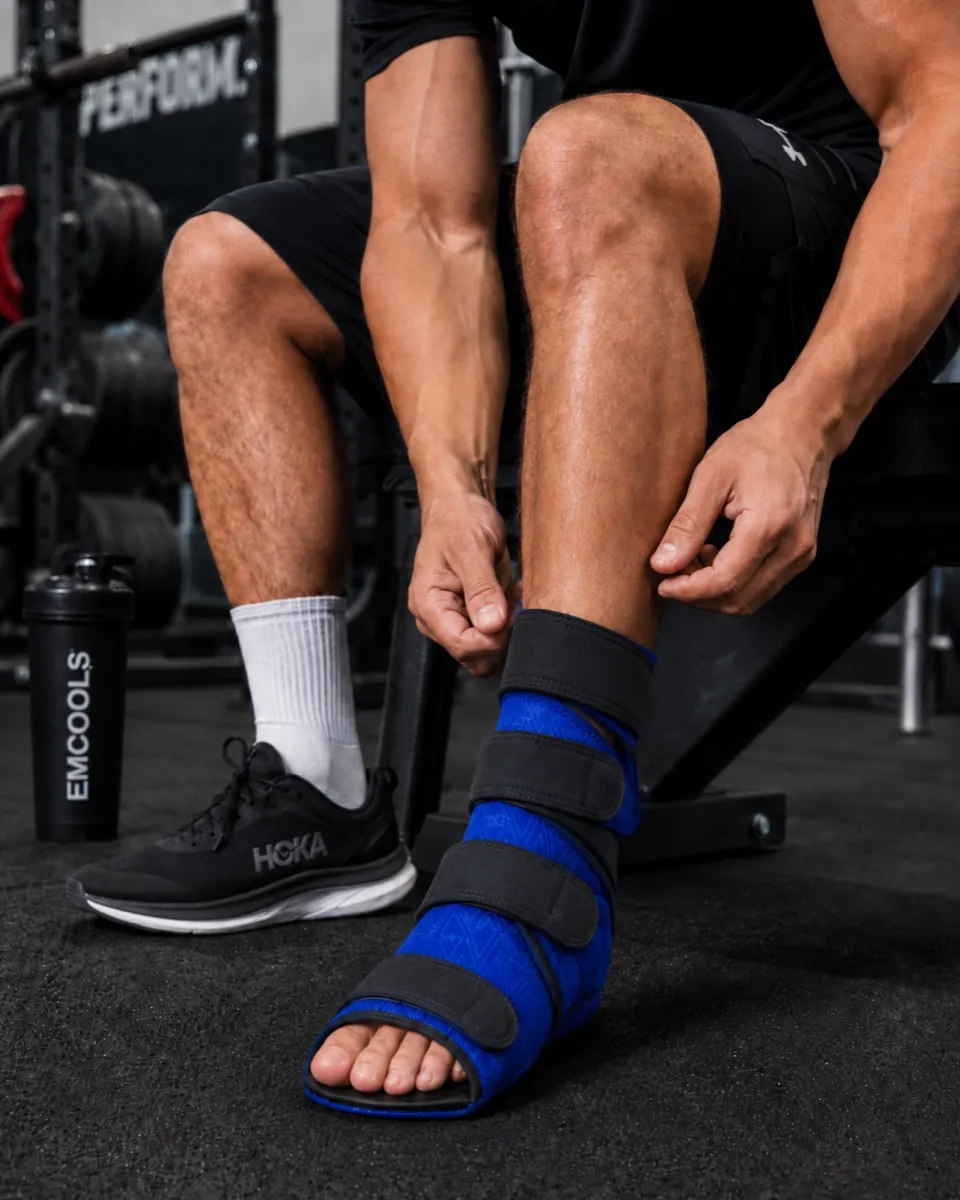
Recoolvery+ is not an ice pack. It's a cooling recovery wrap: freezable HypoCarbon® pads held on by three straps. The pads stay cold for 15 to 60 minutes, depending on room temperature and fit.[8]
That's how long the pads last, not a target. Start with 15 to 20 minutes, check your skin after the first 10, and wear it over a thin layer if you prefer it gentler. For an injury, follow the same timing as above.
HypoCarbon® conducts heat about 15 times better than ice (35.0 vs 2.3 W/m·K), so it draws heat from the skin quickly.[9][10] That's the reason to check the skin early rather than leaving it on and forgetting it. The pads firm up in the freezer without going solid, so they shape around the joint instead of pressing in one spot, and they don't melt or drip.
See the Recoolvery+ Wrap → · Best ice pack for the knee →
Questions
How long should you ice an injury?
Up to 20 minutes at a time, every 2 to 3 hours while you're awake, for the first few days, with a cloth between the ice and your skin. A pattern of 10 minutes on, 10 minutes off, 10 minutes on also works well.
Is it better to ice for 20 minutes or 10 on and 10 off?
Both work. In a 2006 trial of ankle sprains, people using 10 minutes on, 10 minutes off, 10 minutes on had less pain on activity at one week than people icing for 20 minutes continuously. Swelling and function were the same.
Can you ice for too long?
Yes. Cold left on too long, too tightly or directly on bare skin can injure the skin, and in rare cases nerves that sit close to the surface, such as on the outside of the knee. Take the cold off if the skin goes numb, white, blotchy or painful.
How long should you ice after a workout?
10 to 20 minutes on the sore area, soon after the session, is plenty. Most of the effect on soreness comes in that window.
How many days should you ice an injury?
Ice is most useful in the first few days, while the area is painful and swollen. After that, gentle movement matters more. See a doctor or physiotherapist if it isn't improving.
Can you sleep with ice on?
No. You can't feel the warning signs while asleep, so cold left on overnight can injure the skin. Always take it off before you sleep.
How long should you ice a sprained ankle?
Up to 20 minutes every 2 to 3 hours for the first few days, or 10 minutes on, 10 off, 10 on, wrapped, never directly on bare skin. Rest it and keep it raised when you can.
How long can I wear the Recoolvery+ wrap?
The pads stay cold for 15 to 60 minutes, but that is how long they last, not a target. Start with 15 to 20 minutes, check your skin after 10, and wear it over a thin layer if you prefer it gentler.
References
- NHS. Sprains and strains. www.nhs.uk/conditions/sprains-and-strains/
- Bleakley C, McDonough S, MacAuley D. The use of ice in the treatment of acute soft-tissue injury: a systematic review of randomized controlled trials. American Journal of Sports Medicine, 2004. doi.org/10.1177/0363546503260757
- Bleakley CM, McDonough SM, MacAuley DC, Bjordal J. Cryotherapy for acute ankle sprains: a randomised controlled study of two different icing protocols. British Journal of Sports Medicine, 2006. doi.org/10.1136/bjsm.2006.025932
- Bassett FH, Kirkpatrick JS, Engelhardt DL, Malone TR. Cryotherapy-induced nerve injury. American Journal of Sports Medicine, 1992. doi.org/10.1177/036354659202000505
- Algafly AA, George KP. The effect of cryotherapy on nerve conduction velocity, pain threshold and pain tolerance. British Journal of Sports Medicine, 2007. doi.org/10.1136/bjsm.2006.031237
- Dubois B, Esculier JF. Soft-tissue injuries simply need PEACE and LOVE. British Journal of Sports Medicine, 2019 (print 2020). doi.org/10.1136/bjsports-2019-101253
- Machado AF, Ferreira PH, Micheletti JK, et al. Can water temperature and immersion time influence the effect of cold water immersion on muscle soreness? A systematic review and meta-analysis. Sports Medicine, 2016. doi.org/10.1007/s40279-015-0431-7
- Recoolvery+ product specifications and care guide: session length, refreeze time, pad life and materials. recoolvery.com/products/recoolvery-wrap
- HypoCarbon® thermal conductivity (35.0 W/m·K): Global Healthcare SG in-house testing of the proprietary formulation. Unpublished company data, available to clinical and trade partners on request.
- Slack GA. Thermal conductivity of ice. Physical Review B, 1980. doi.org/10.1103/PhysRevB.22.3065
Recoolvery+
Cooling for your recovery routine
Not an ice pack. Freezable HypoCarbon® pads in a hands-free wrap for the knee, shoulder, elbow, ankle and back. HypoCarbon® conducts heat 15× better than ice. Cold only, no heating.
See the Recoolvery+ Wrap