Compare
Gel ice pack vs cooling wrap: which reusable cold pack is better?
A gel pack is the default reusable cold pack, and for a quick bump it's fine. Used every day for recovery, its limits show: it cools less than ice, it won't stay on, and it's either rock-hard or not very cold. Here's what's inside a gel pack, what the studies say, and how a cooling wrap compares.
General information, not medical advice. For an injury, or pain that is severe or not improving, see a doctor or physiotherapist.
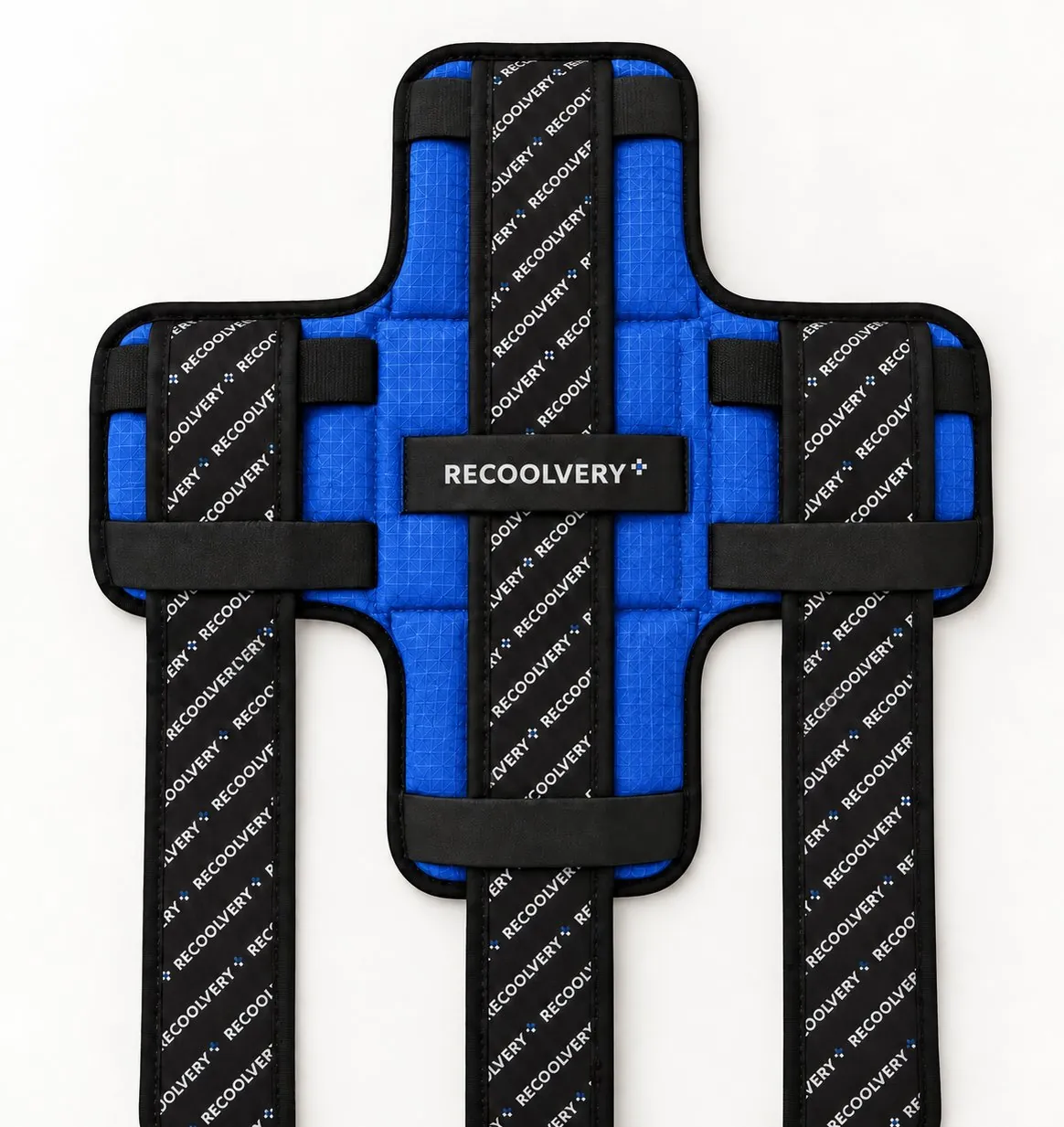
A gel ice pack is cheap, reusable and fine for a quick bump or a lunch box. For regular recovery it has three weaknesses: it cools the skin less than ice,[1] it slides off unless you strap it, and it either freezes stiff or stays soft but holds less cold. A cooling wrap fixes the fit and hands-free problems. Recoolvery+ also replaces the gel with freezable HypoCarbon® pads that conduct heat about 15 times better than ice[5][6] and firm up without going solid.
What's inside a gel ice pack
Most gel packs are mostly water, thickened into a gel so it doesn't slosh. Manufacturers face a trade-off: plain water gel freezes hard like an ice block, so many soft, "flexible" packs add an antifreeze to stop them freezing solid. That keeps them bendy, but a pack that never fully freezes holds less cold, so it warms up sooner.
Ice is so good at cooling partly because melting absorbs a large amount of heat. A pack that doesn't freeze solid gets less of that benefit. In a 2005 study comparing four cold treatments on the thigh, a gel pack and frozen peas lowered skin temperature less than an ice pack throughout a 20-minute application.[1] A 2009 study found wetted ice (ice with water added) cooled the skin more than cubed or crushed ice.[2] Water itself is a poor conductor of heat (0.6 W/m·K)[7] compared with ice (2.3).[6]
Gel ice pack vs Recoolvery+ cooling wrap
| Gel ice pack | Recoolvery+ cooling wrap | |
|---|---|---|
| Cooling medium | Water-based gel, sometimes with antifreeze | HypoCarbon®, 35.0 W/m·K[5] |
| How it feels from the freezer | Stiff, or soft but less cold | Firms up without going solid, so it shapes to the joint |
| Stays on | Only if you hold it or add a strap | Yes, cross-shaped holder and three adjustable straps |
| Coverage on a knee or shoulder | Mostly one flat side | Wraps the front and both sides |
| Leaks | One thin pouch; a puncture leaks gel | TPU casing with sealed cells |
| Session length | Varies by size and brand | 15–60 minutes; refreezes in 2–4 hours[4] |
| Lifespan | Until it splits or goes hard and lumpy | Pads built for up to 2 years of daily use[4] |
| Cost | Low | US$119 Standard · US$139 XL |
| Best for | Occasional bumps and bruises, lunch boxes | Regular cooling after training, hands-free, at home or on the go |
When a gel pack is all you need
To be fair: if you bang your shin once a year, a gel pack from the pharmacy is the sensible buy. It's cheap, it lives in the freezer, and for a few minutes of cooling on a flat area it does the job. Wrap it in a thin towel, keep it on for up to 20 minutes,[3] and replace it if it splits. A cooling wrap earns its place when you cool the same joints often, after training, at a physio clinic or after long days on your feet, and want it to stay put while you get on with things.
What to look for in any reusable cold pack
- Gets properly cold and stays cold long enough for a 15 to 20 minute session.
- Flexible straight from the freezer, so it touches the skin instead of bridging across a joint.
- A way to hold it on: built-in straps beat a separate sleeve.
- Tough casing, with seams that won't split after a few months of freezing.
- Fits the joint you use it on: a flat rectangle suits a calf or back better than a knee or shoulder.
- Easy to clean: a casing you can wipe down, especially if it's shared.
Safety, whichever you choose
Keep a thin layer between anything straight from the freezer and bare skin, check the skin after 10 minutes, and take it off if it goes numb, white or painful. Never sleep with a cold pack on. If a gel pack leaks, wipe it off the skin and wash with soap and water. Keep packs away from children and pets, and contact a poison information service if one is chewed or swallowed. How long to ice →
See the Recoolvery+ Wrap → · Best ice pack for the knee → · Cold therapy machine vs cooling wrap →
Questions
Are gel ice packs better than ice?
For convenience, yes: they're reusable and don't drip. For cooling, no: a 2005 study found an ice pack lowered skin temperature more than a gel pack over 20 minutes.
Why do some gel packs stay soft in the freezer?
Many flexible gel packs contain an antifreeze so they don't freeze solid. That keeps them bendy, but a pack that never fully freezes holds less cold and warms up sooner.
How long does a gel ice pack stay cold?
It depends on its size, contents and how cold your freezer is. Small soft packs warm up fastest. For an injury, you only need up to 20 minutes at a time anyway.
Can you put a gel pack directly on skin?
It's safer not to. Keep a thin cloth between the pack and your skin, check the skin after 10 minutes, and take it off if it goes numb, white or painful.
Are gel ice packs toxic if they leak?
Contents vary by brand. Wipe leaked gel off the skin and wash with soap and water. Keep packs away from children and pets, and contact a poison information service if one is chewed or swallowed.
What is the best reusable ice pack?
One that gets properly cold, stays flexible from the freezer, holds itself on and has a tough casing. For occasional use a gel pack is fine. For regular recovery, a strap-on cooling wrap such as Recoolvery+ is hands-free and built to last.
Is Recoolvery+ a gel pack?
No. Its RCPad pads contain HypoCarbon®, a carbon-based cooling medium measured at 35.0 W/m·K in in-house testing, compared with 2.3 for ice. They firm up in the freezer without going solid and sit in a TPU casing with sealed cells.
References
- Kanlayanaphotporn R, Janwantanakul P. Comparison of skin surface temperature during the application of various cryotherapy modalities. Archives of Physical Medicine and Rehabilitation, 2005. doi.org/10.1016/j.apmr.2004.11.034
- Dykstra JH, Hill HM, Miller MG, Cheatham CC, Michael TJ, Baker RJ. Comparisons of cubed ice, crushed ice, and wetted ice on intramuscular and surface temperature changes. Journal of Athletic Training, 2009. doi.org/10.4085/1062-6050-44.2.136
- NHS. Sprains and strains. www.nhs.uk/conditions/sprains-and-strains/
- Recoolvery+ product specifications and care guide: session length, refreeze time, pad life and materials. recoolvery.com/products/recoolvery-wrap
- HypoCarbon® thermal conductivity (35.0 W/m·K): Global Healthcare SG in-house testing of the proprietary formulation. Unpublished company data, available to clinical and trade partners on request.
- Slack GA. Thermal conductivity of ice. Physical Review B, 1980. doi.org/10.1103/PhysRevB.22.3065
- Ramires MLV, Nieto de Castro CA, Nagasaka Y, et al. Standard reference data for the thermal conductivity of water. Journal of Physical and Chemical Reference Data, 1995. doi.org/10.1063/1.555963
Recoolvery+
Cooling for your recovery routine
Not an ice pack. Freezable HypoCarbon® pads in a hands-free wrap for the knee, shoulder, elbow, ankle and back. HypoCarbon® conducts heat 15× better than ice. Cold only, no heating.
See the Recoolvery+ Wrap